πŸ”’ Confidential Project

UT Move

UniFi Β· Under NDA
Category
Dual-Mode Walkie-Talkie
Network
LoRa + WiFi
Key Challenge
Stacking / System Scenario
Status
Unreleased Development
πŸ”’
This project is protected under a client Non-Disclosure Agreement (NDA). The images and details presented below are for portfolio evaluation only β€” please do not redistribute, screenshot, or share. Thank you for respecting intellectual property.
UT Move mainboard research and stacking architecture
01

Mainboard & Stacking

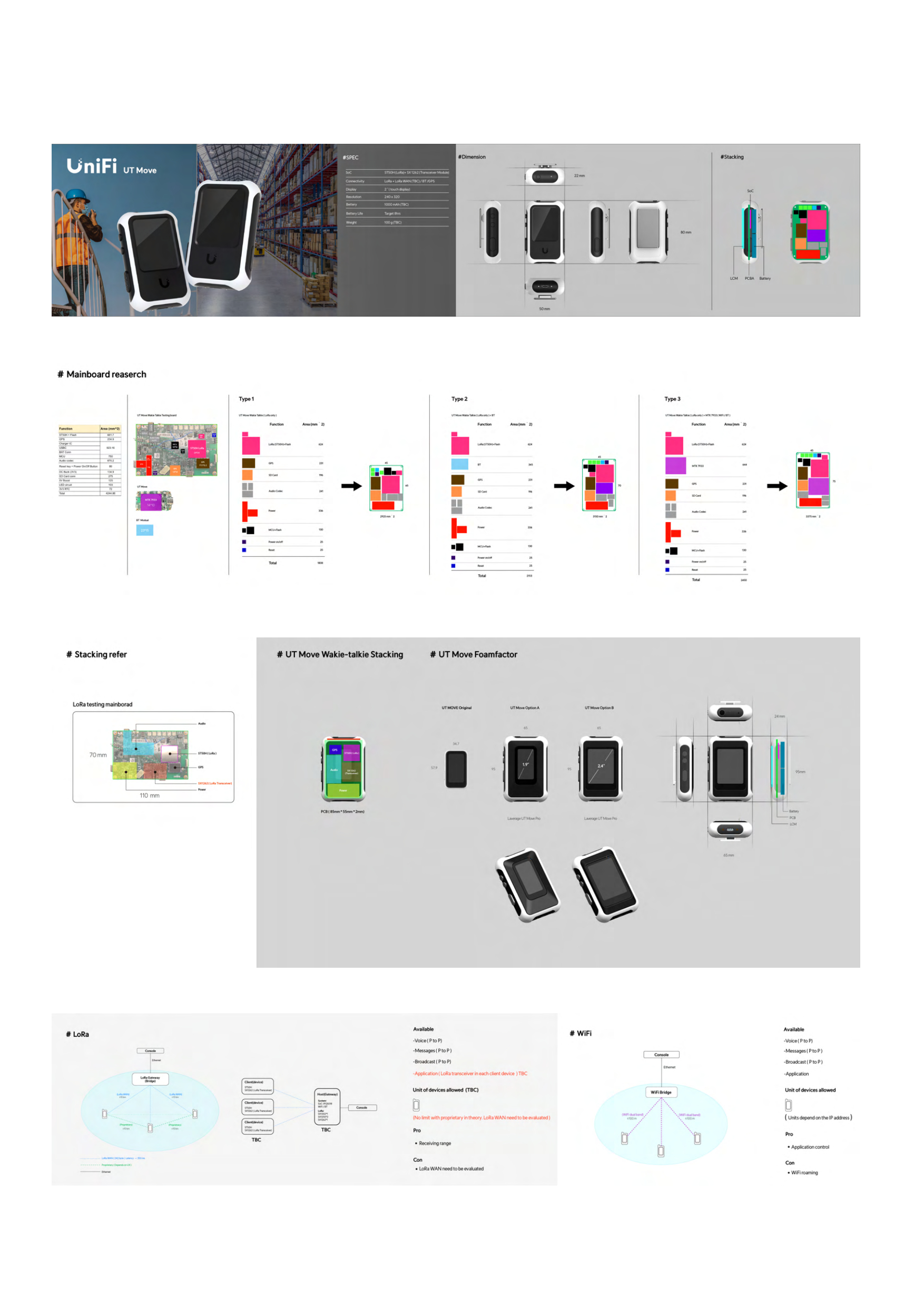
Led the mainboard layout and stacking architecture development for a LoRa/WiFi dual-mode walkie-talkie device, progressively optimizing component density and internal space utilization within fixed product dimensions.
  • Mainboard iterations: Defined three configurations (Type 1-3), trading off different size targets and function combinations while systematically evaluating PCB area utilization and thermal paths.
  • Stacking architecture: Compared the original walkie-talkie stacking with two new form-factor proposals (UT Move Option A / B), defining the 3D relationships between PCB, battery, and antenna.
  • Wearable form studies: Explored wearable stacking formats and foam form-factor studies, balancing battery life, product volume, and wearing ergonomics.
UniFi hotel device ecosystem overview
02

UniFi Hotel Ecosystem

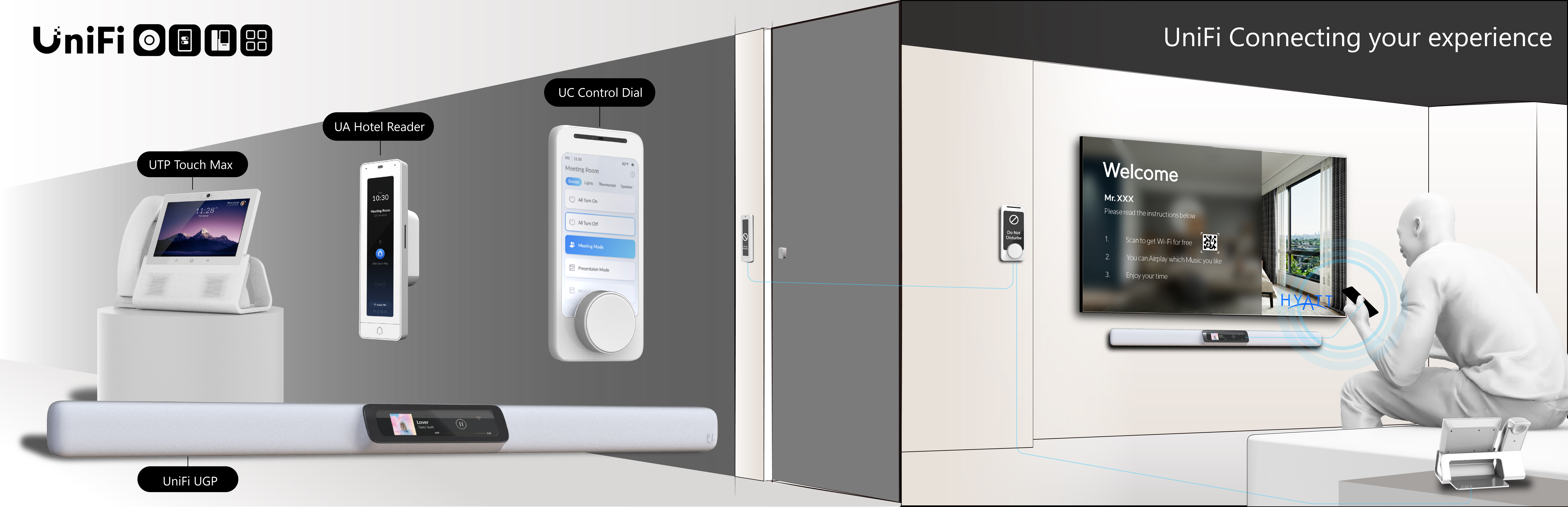
Extended from the UT Move product context, I defined an entire UniFi hotel ecosystem β€” including UTP Touch Max, UA Hotel Reader, UC Control Dial, and UniFi UGP β€” to build a complete in-room and out-of-room interaction experience.
  • UTP Touch Max: A large-screen touch device for lobby or guest room, integrating meeting and environmental control.
  • UA Hotel Reader: The door-access device outside each guest room, using NFC for check-in and identification.
  • UC Control Dial: An in-room scene control dial for quickly switching between lighting, music, and AC modes.
  • UniFi UGP: A large in-room touch strip integrating voice and scene synchronization.
UniFi hotel complete guest journey
03

Guest Journey

Designed complete user flows for two scenarios β€” first-time and returning guests β€” creating a seamless, intuitive check-in experience while reinforcing the hotel brand memory.

  • First-time check-in: Mobile booking β†’ walk to the room (no front desk) β†’ tap Hotel Reader via NFC β†’ light and sound guide entry β†’ Control Dial sets the room scene.
  • Check-out & cleaning cue: After the guest leaves, the Reader screen automatically switches to a "Clean the Room" prompt, triggering the housekeeping workflow.
  • Returning guest personalization: On a second stay, the system automatically recognizes the guest and pre-sets lighting, music, and ambient scenes based on prior behavior β€” reinforcing brand recall.
UniFi hotel system architecture and scenarios
04

System Architecture

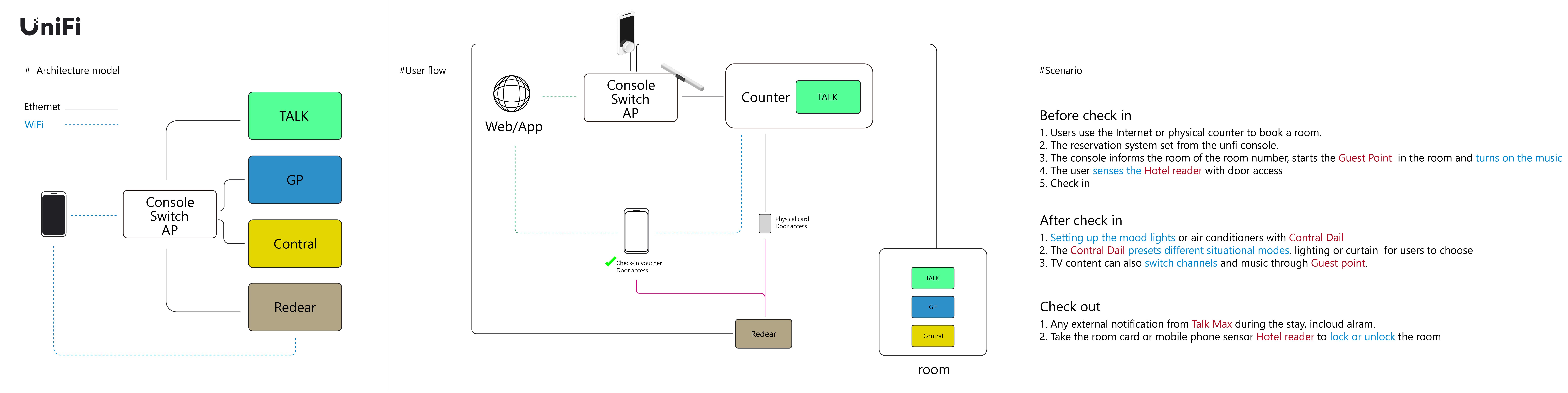
From device level to scenario level, I defined a full system architecture ensuring that all devices operate in unison through UniFi Console/Switch/AP.

  • Device topology: Console/Switch/AP as the core, connecting TALK, GP, Control, and Reader device types to form a hotel-grade networking topology.
  • Before check-in: Web or front-desk reservation β†’ system sets the room number β†’ Guest Point activated β†’ tap Hotel Reader β†’ check-in complete.
  • After check-in: Control Dial provides preset scene modes (lighting, curtains, TV channels, music) for quick switching by the guest.
  • Check-out: External notifications (including alarms) delivered via Talk Max; use the room card or phone to tap Hotel Reader for lock-out.