Project 08 — Off-Grid Networking

Solar Mesh

UniFi Solar Point · Ubiquiti
Deployment
Western US Ranches
Key Challenge
Single-Person Install
Network
LoRa + WiFi 2.4GHz
Target
Precision Livestock
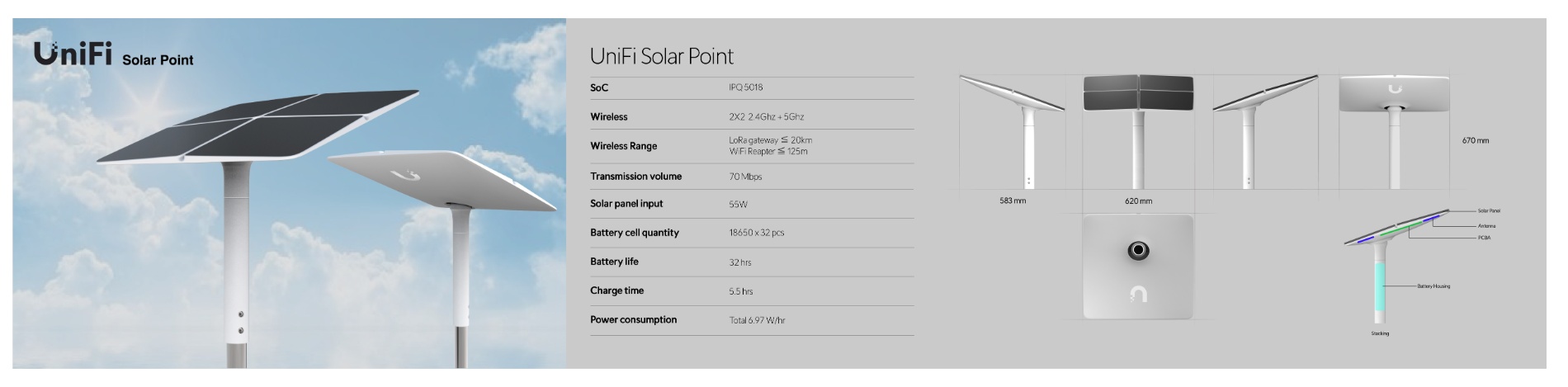
UniFi Solar Point product overview and full specs
Solar Mesh product — solar panel and canopy structure
00

Product Overview

Solar Mesh is an off-grid wireless node in the UniFi Solar Point family, purpose-built for the vast, remote terrain of the American West where grid power is unavailable. The overall form language centers on a single-person installability, paired with solar auto-tracking and 9-hour battery life to achieve optimized energy harvesting in truly off-grid conditions.
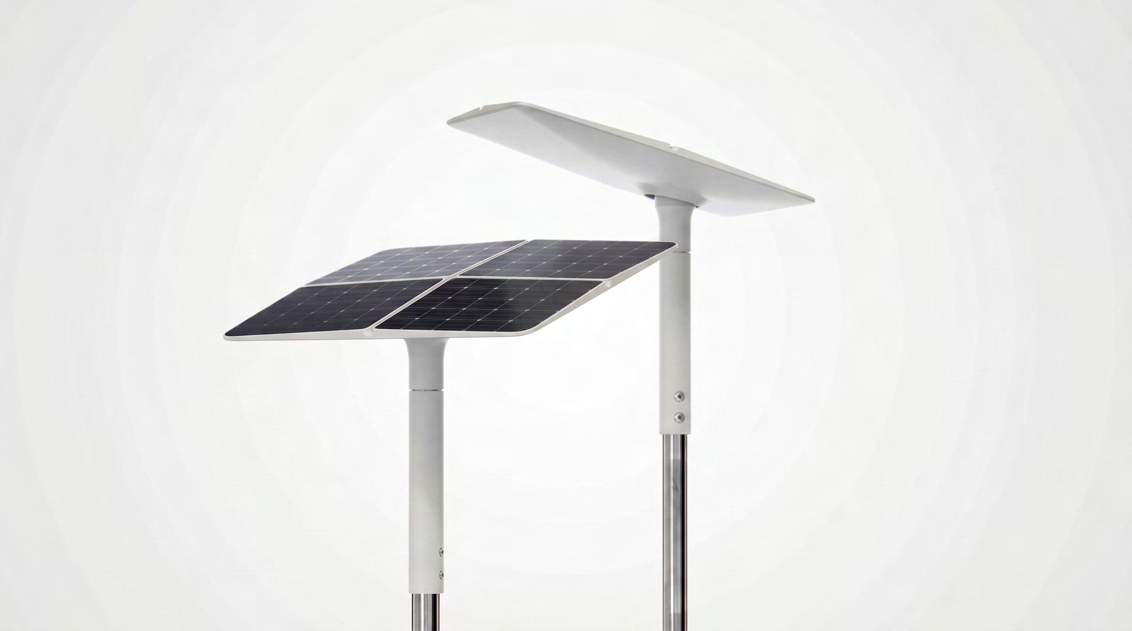

  • User experience & scenario layout: Integrated solar auto-tracking, with 9-hour battery life to optimize energy harvesting in off-grid environments.
  • Form & environmental semantics: A pure geometric volume with a four-sided sloped canopy — not only expressing the product’s functional metaphor, but strategically deterring birds from perching and mitigating heavy ice and snow buildup in harsh outdoor environments.
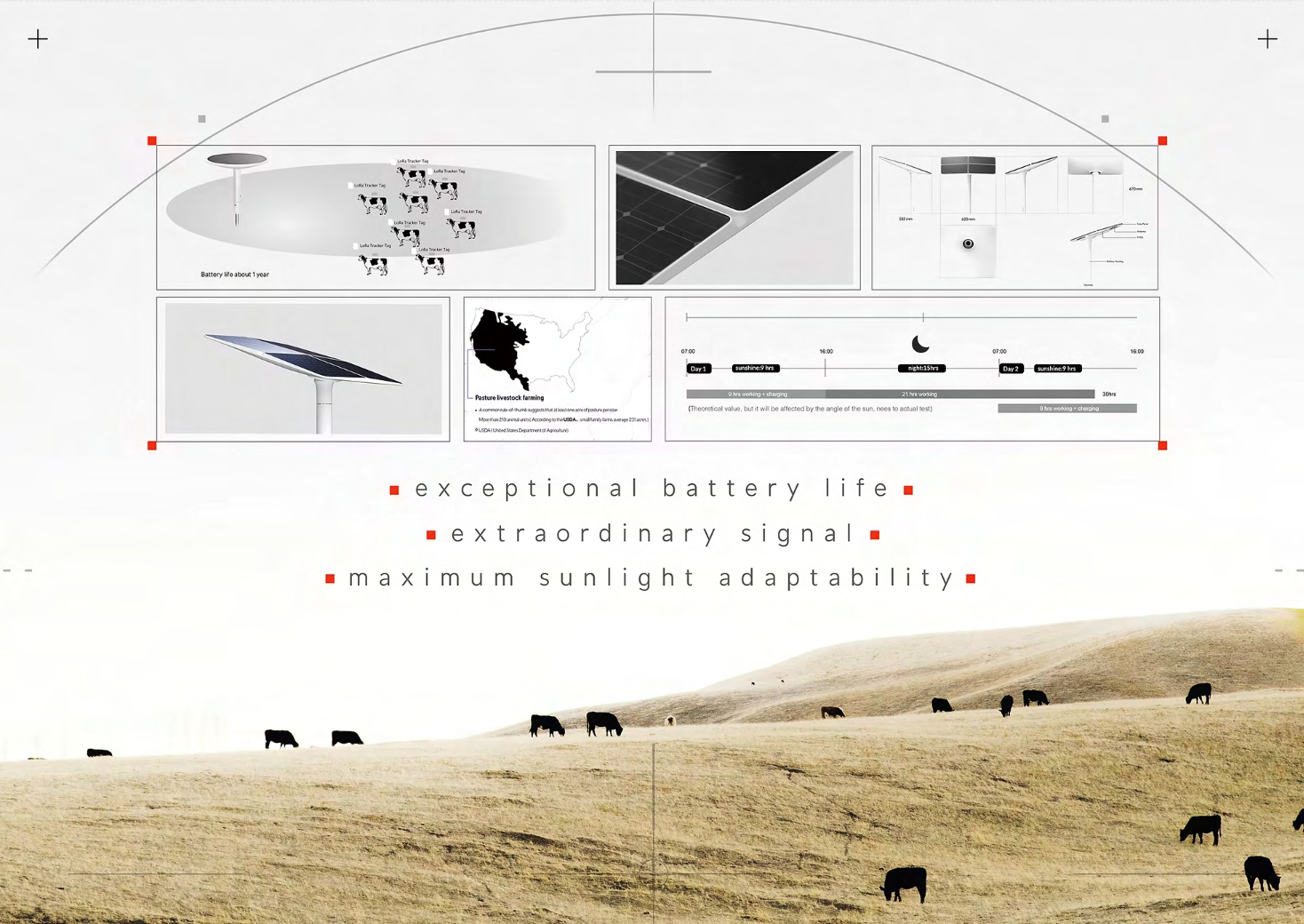
Solar Mesh application scenario — Western US ranch and battery-life concept
Use case comparison — WiFi 2.4GHz vs LoRa Gateway
01

Use Case Study

The design starts by evaluating the real-world feasibility of two wireless technologies — WiFi and LoRa — for precision livestock scenarios, using situational modeling to identify the target user's actual pain points.
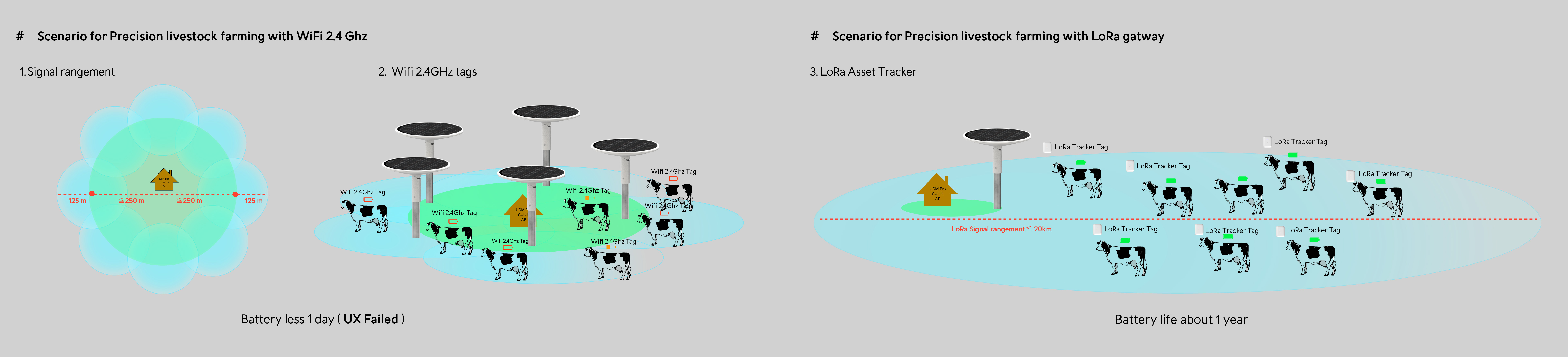
  • WiFi 2.4GHz option: Signal range limited to ~250 m; cattle tag batteries drain in under a day — UX failure.
  • LoRa Gateway option: Signal range up to 20 km with ~1-year tag battery life — practical for large-scale ranch operations.
Conclusion: A single Solar Point running on LoRa can cover an entire mid-sized ranch, dramatically simplifying deployment.
Western US ranch sizing and Solar Point coverage calculation
02

Market Sizing

Benchmarking against the Western US livestock industry, I quantified the actual device count needed per ranch to validate the product positioning.
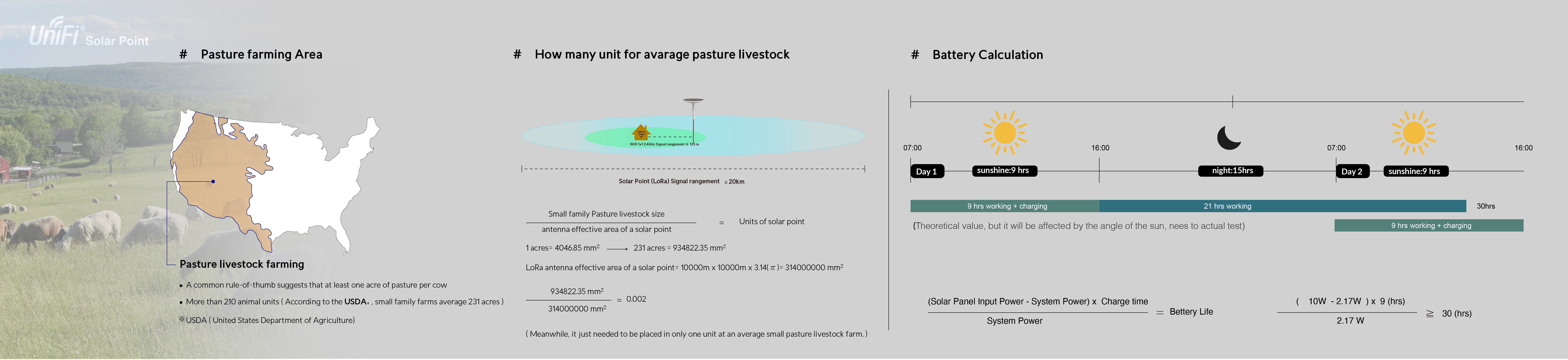
  • Ranch size reference: Per USDA data, small US family ranches average 231 acres; a common rule-of-thumb is at least 1 acre of pasture per cow.
  • Coverage calculation: A single Solar Point's LoRa antenna effective area reaches 314,000,000 mm² (10 km radius circle), far exceeding the 934,822 mm² needed for a small ranch.
  • Result: On average, one Solar Point fully covers an entire small family ranch.
Solar Point battery life calculation
03

Battery Life Calculation

Energy autonomy is the core of an off-grid system. Based on average sunlight conditions in the Western US, I calculated the balance between solar charging and system consumption to derive theoretical battery life.
  • Sunlight assumption: Day 1 — 9 hrs working + charging → Night — 15 hrs working only → Day 2 — 9 hrs of recharge.
  • Life formula: (Solar input power − System power) × Charge time ÷ System power = Battery life.
  • Result: (10W − 2.17W) × 9 hrs ÷ 2.17W ≥ 30 hrs — theoretically endures ~30 hours of continuous no-sunlight operation, roughly a full day of autonomy.
Note: This is a theoretical value; actual performance depends on solar incidence angle and must be verified through field testing.
Solar Point dimensions and battery selection
04

Form & Battery

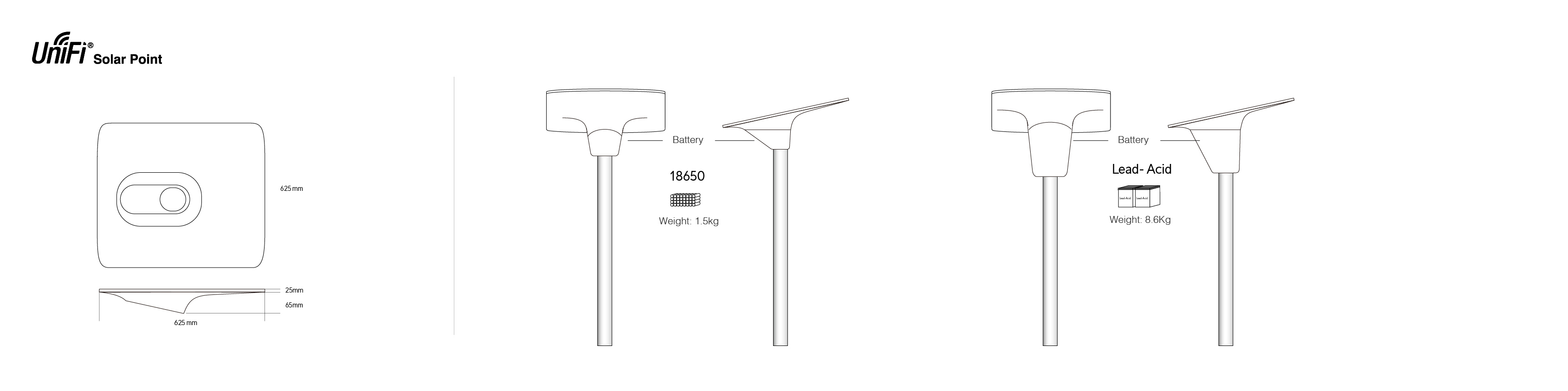
From structural design to battery selection, every decision revolves around the core requirement of single-person installability.
  • Panel dimensions: 625 × 625 mm photovoltaic panel, just 25 mm thick with a 65 mm main body — balancing collection efficiency and transport volume.
  • Battery choice: 18650 Li-ion pack (1.5 kg) vs lead-acid (8.6 kg). Chose 18650 — nearly a 6× weight reduction, making single-person transport to remote sites feasible.
Solar Point three-step single-person installation
05

Installation Flow

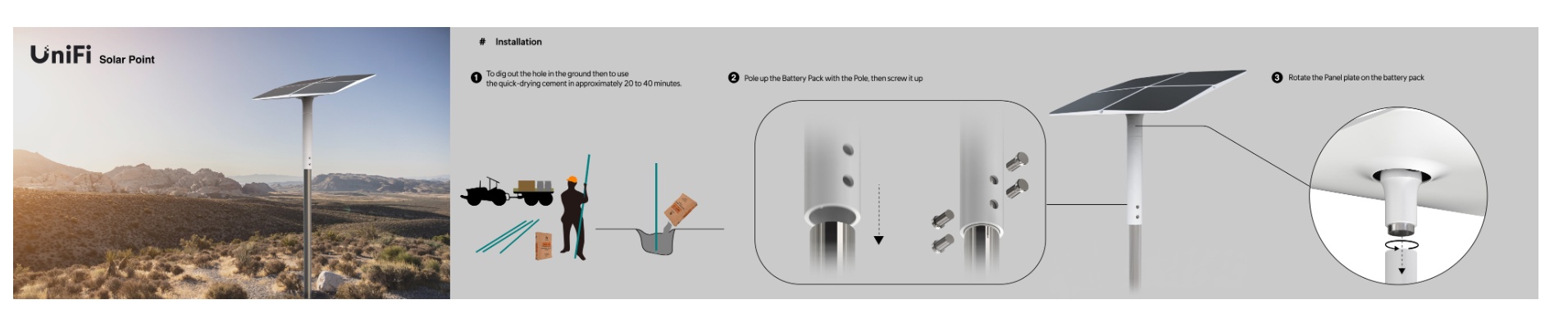
The single-person install promise breaks down into three concrete steps — paired with quick-drying cement, the entire deployment can be completed on-site in one visit.

  • Step 01. Dig the ground hole and pour quick-drying cement — cures in 20-40 minutes.
  • Step 02. Pole up the battery pack and screw it onto the base.
  • Step 03. Rotate the panel plate onto the battery pack — no tools required, no second person needed.